Your team's blind spot + tool to surface it
A few weeks ago I sat in a room with a team of truly brilliant people, high performers, some of the best in their industry, working inside one of the fastest growing companies in the world.
We were gathered for a half day offsite, and what struck me most was the level of vulnerability they were willing to bring. They were honest about how they were really feeling as a team, not performing for optics.
Few teams stop to ask deeper, more fundamental questions like... How connected do we actually feel as human beings? And how do we actually work best together?
Google's Project Aristotle found that the number one driver of team performance was not seniority, technical skill, or experience. It was psychological safety and trust. And trust is built through genuine human connection.
So that is exactly what we did.
We started by connecting as humans. Each person shared three chapters of their life. Not credentials or career highlights, but moments that shaped who they are today. The team leader went first, modeling vulnerability, and that made everything work.
From there, we looked at how the team saw itself.
Before the workshop, everyone anonymously completed a short assessment rating the team across fifteen behaviors linked directly to trust and performance grouped into into key 5 categories:
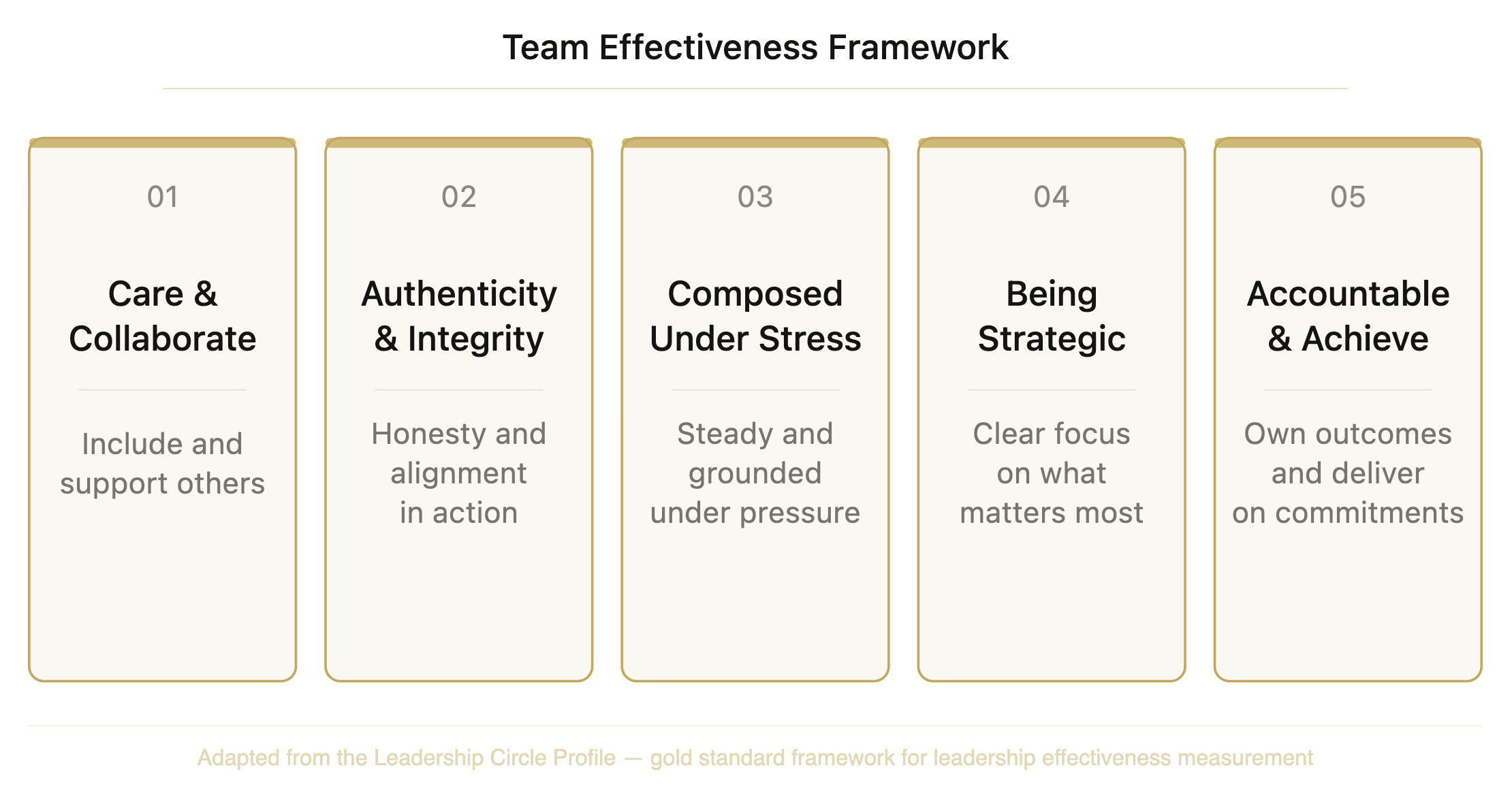
The scores gave the team a shared mirror for how they see themselves, the team’s strengths and areas of growth, and a baseline to build on.
By the end of our half day together, the team had co-created a set of shared agreements for how they wanted to work together going forward.
My coach Ann has this beautiful metaphor about the difference between helping a fish and improving the quality of the water. My goal is to go beyond supporting the leader, to improving the conditions for everyone. And it is some of the most meaningful work I have ever done.
And each of you has the opportunity to improve the quality of the water in your own ecosystem. If your team is scaling fast, navigating a reorg, or you simply have that instinct that something underneath is not quite right, that instinct is worth listening to.
A tool you can use with your team this week:
Take fifteen minutes in your next team meeting and ask these three questions. Have everyone answer independently first, then share.
On a scale of one to ten, how connected do we feel as a team right now?
On a scale of one to ten, how well do we feel we are working together?
What is one thing we are doing really well, and one thing we could do better together?
The conversation that follows will tell you everything you need to know about where to start.
If you want to go deeper, reply to this email. I will share the full fifteen-behavior team assessment your team can complete anonymously in 2 minutes, and we can talk about what the results might mean for your team.
Here’s to improving the quality of the water for everyone.
With love and courage,
Ramona
Hi, I’m Ramona, founder and executive leadership coach partnering with senior leaders, founders, and organizations to build the leadership capacity needed to lead effectively through growth, transition, and ambiguity.
I’ve coached leaders and facilitated leadership development for organizations including Google, Meta, Adobe, Cisco, Deloitte, Accenture, Anthropic, Warner Media, Nordstrom, Mars, Vuori, VC firms, and scaling startups, supporting leaders navigating increased scope, complexity, and pressure.
My approach integrates leadership strategy, evidence-based coaching, emotional intelligence, neuroscience, and mindfulness to help leaders think more clearly, communicate more effectively, and lead with authentic confidence as their roles evolve.
My credentials include:
IPEC Certified Leadership Coach
Leadership Circle Profile (LCP) coach Certified Positive Intelligence Coach Emotional Intelligence Trainer Mindfulness Meditation Teacher.
Before coaching, I spent years in senior marketing research and strategy roles at companies including Twitter, eBay, Ancestry, and StubHub, so I deeply understand the pressures of corporate leadership.
I believe that when leaders embody their highest potential, they don’t just advance their careers and organizations—they create ripples of positive change.